
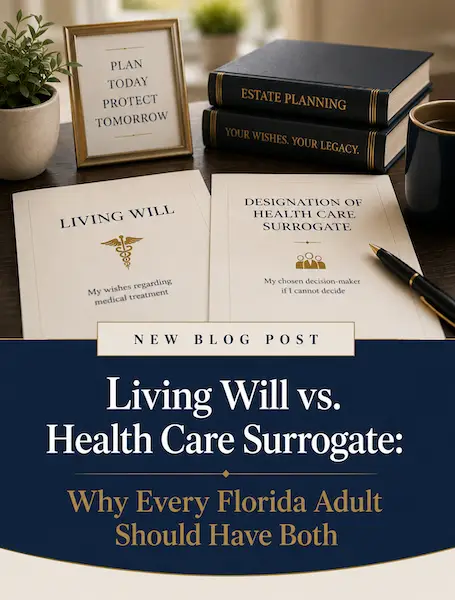

Many people assume a living will and a health care surrogate designation are the same document, but under Florida law, they serve two very different purposes. Having both in place ensures your wishes are clearly communicated and that someone you trust can make medical decisions on your behalf if you’re unable to do so.
A Living Will allows you to provide instructions about your preferences for end-of-life medical care. It outlines your wishes regarding life-prolonging treatments if you have a terminal condition, an end-stage condition, or are in a persistent vegetative state and are no longer able to communicate your decisions.
A Designation of Health Care Surrogate (Florida’s version of a health care power of attorney) allows you to appoint someone you trust to make medical decisions on your behalf if you become incapacitated. Your surrogate can communicate with your physicians, review medical records, and make health care decisions consistent with your wishes.
Both documents should be prepared as part of a comprehensive Florida estate plan to ensure they comply with Florida law and are properly executed. Because witnessing and signing requirements vary by state, it’s important to have documents specifically drafted for Florida residents.
These documents must be signed while you have the legal capacity to understand what you’re signing. Once a person becomes incapacitated, they generally cannot execute new estate planning documents.
A living will becomes effective only under specific circumstances outlined in Florida law—typically when a person has a terminal condition, an end-stage condition, or is in a persistent vegetative state and cannot communicate their wishes. At that point, the document provides guidance regarding treatments such as mechanical ventilation, artificial nutrition and hydration, and other life-prolonging procedures.
The more specific your instructions, the easier it is for your loved ones and health care providers to honor your wishes during an emotional and often stressful time.
Your Designation of Health Care Surrogate works alongside your living will by giving your chosen surrogate the authority to make medical decisions that may not be specifically addressed in your written instructions. Together, these documents help eliminate uncertainty and reduce the likelihood of disagreements among family members during a medical crisis.
It’s also important to understand that a Living Will is not the same as a Last Will and Testament. A Last Will directs how your assets are distributed after your death, while a Living Will addresses medical treatment decisions during your lifetime.
Likewise, a Durable Power of Attorney is different from a Designation of Health Care Surrogate. A Durable Power of Attorney authorizes someone to manage your financial and legal affairs, while your Health Care Surrogate is responsible for making medical decisions.
Each of these estate planning documents serves a unique purpose. When properly prepared and coordinated, they work together to protect your wishes, ease the burden on your loved ones, and provide peace of mind for you and your family.
If you haven’t created these essential documents yet, Smylie Legacy Law’s Adulting Package is designed to help Florida adults establish the legal foundation everyone should have in place. The package includes a Living Will, Designation of Health Care Surrogate, General Durable Power of Attorney, and HIPAA Authorization and Release, providing peace of mind that your medical wishes, financial affairs, and privacy are protected if the unexpected happens. Whether you’re a young professional, newly married, a parent, or simply checking an important item off your to-do list, having these documents in place is one of the most important steps you can take to protect yourself and your loved ones.
Reference: Adapted from The News-Gazette (June 14, 2026), “The Law Q&A | What happens when living will, power of attorney collide?” and updated to reflect Florida estate planning terminology and laws.